
Employer Strategies

SmithRx
Key Takeaways
Opt for transparent, fixed-fee PBM models to eliminate hidden drug costs and spread pricing.
Build PBM procurement leverage by starting competitive RFPs 10-12 months before renewal.
Protect your pharmacy budget with full PBM contract auditing and claim-level data rights.
While pharmacy benefit manager (PBM) evaluations may only happen every few years, the financial implications of that choice permeate every day for financial leaders. It’s just one contract, but it has broad implications for the fiscal sustainability of your organization’s benefit offerings.
When working with legacy PBM, something as minor as missing a single negotiation point or loophole can have dire consequences for your plan. So, what do you do? No level of financial expertise or having your general counsel pore over agreements will protect your company from a PBM acting in bad faith. When you’re negotiating with the nation’s largest, legacy PBMs, your contract isn’t designed to guarantee your savings. It’s designed to serve the PBM’s vertical-integrated interests exclusively.
If your PBM contract touts ‘guaranteed’ discounts, but doesn’t cement your rights as a client, then the financial reality of your relationship is obscured via the legacy PBM black-box structure. It doesn’t protect your interests, it just serves to trap you.
By contrast, modern PBM contracts are a strategic asset. A truly transparent, modern agreement will give you option value (the ability to audit, optimize, and hold your PBM accountable), rather than protecting the PBM’s leverage solely. Successful PBM contract negotiations in 2026 aren’t about your discount volume, but rather, securing the financial control and true partnership parameters you need to carry your benefits into the next decade and beyond.
The Hidden Cost of the Status Quo
The fear that signing the ‘wrong’ PBM contract for your business's bottom line is not at all unfounded. As of 2024, nearly one-fourth (24%) of total employer healthcare spend was on prescription drugs and continued an upward trend from 21% in 2021. This unchecked spend is often reported as a top concern by benefits leaders at organizations of all sizes.
In 2025, total prescription drug spend increased by 12.7% to $915 billion. This year-over-year spending growth rate from 2024 is one of the highest from the last 20 years, and outpacing spending increases in healthcare and the total economy. While landmark drugs like GLP-1s do factor into these rapid spend increases, they’re also driven by rampant PBM mismanagement of employer healthcare dollars.
To further complicate matters, most of today’s employers have little to no visibility into what’s truly driving spend. The FTC reported that the 3 largest, legacy PBMs process 80% of the prescriptions dispensed by U.S. pharmacies in 2023. These industry ‘giants’ have a vested interest in obscuring the true cost of drugs from employers. They don’t want benefits and financial leaders catching onto their pricing games and vertically-integrated systems that nearly exclusively support their own interests.
For shrewd financial leaders and CFOs this presents a dilemma: you're managing one of your fastest-growing cost centers with the least visibility. The key to getting more visibility as a right? Selecting the correct PBM partner and leveraging your contract as a tool for true accountability.
PBM Procurement Leverage: What It Really Means
In legacy, and even some so-called ‘pass through’, PBM contracting processes, employers will fight tooth and nail to get a ‘better deal’ at renewal. It’s an often painful process just to get sub-par results, and it still leaves your team without procurement leverage.
The pharmacy benefit contract procurement process allows plan sponsors and employers to search for and identify potential PBMs, determine critical contract terms, leverage competitive pressure against their incumbent provider, and ultimately find opportunities to curb pharmacy spend. By implementing a competitive procurement process, employers can save their budgets, as compared to staying within the loop of restrictive legacy contracts.
Curious about the ideal timeline for running a Request for Proposal (RFP) that maximizes your procurement leverage? Watch our webinar with Mercer, a Marsh business, to get RFP best practices and timelines.
True procurement leverage in pharmacy benefits is predicated on your ability to run a competitive RFP, normalize proposals on an apples-to-apples basis, and retain the right to audit your PBM at any time. If your contract doesn't allow for that, you don't have true leverage. What’s more, you can lose any footing you gain in the procurement process if your PBM contract contains opaque pricing models such as managing to contract and client cross-subsidization to sustain their business.
Fixed-Fee Economics: The Only Model That Aligns Incentives
To ensure pharmacy benefits fiscal sustainability, it’s not enough to maintain your procurement leverage: you have to ultimately align with the right PBM model too. On one hand, you have the discount-based, legacy model, that’s predicated on tactics like spread pricing and rebate retention. On the other, you have a truly modern, cost-based model that leverages a fixed, administrative fee for transparency, accountability, and effective cost-containment.
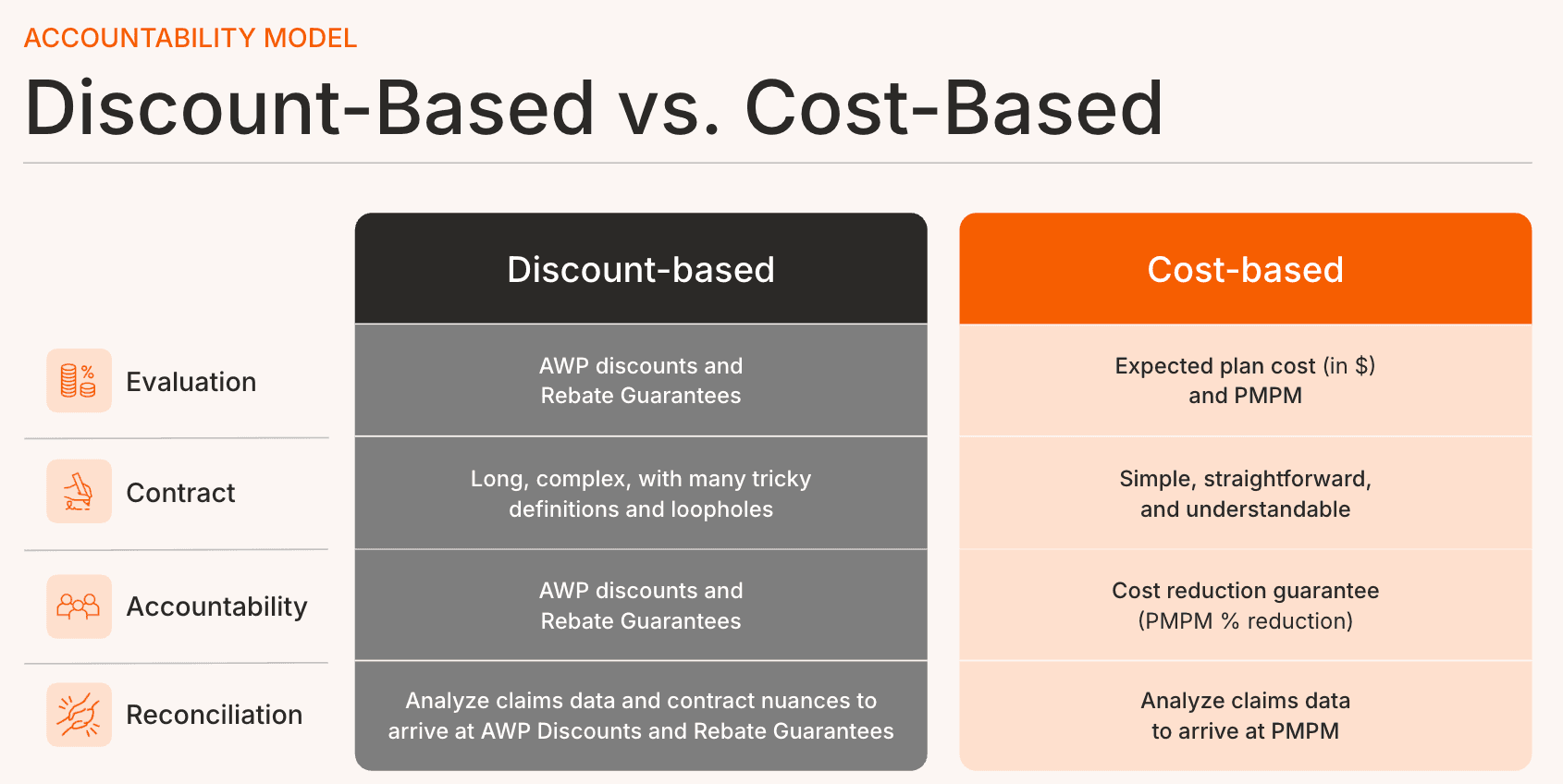
A discount-based model may look fantastic during evaluation, with its promises of steep guaranteed discounts, but its percentage-based fees tied to drug spend create hidden costs and conflicts similar to spread pricing.
In contrast, the fixed, administrative fees of the cost-based model offer no surprises upon billing. The same, flat fee is charged per member, per month (PMPM) and the PBM is free to seek and capture the lowest net cost for the plan. By replacing opaque, legacy revenue streams with clear, fixed administrative fees, fiduciary-aligned PBMs shift from being simple middlemen to transparent benefits partners.
One of the cornerstones of fiduciary alignment is the 100% pass-through pricing model. In this model, the PBM bills the plan sponsor the exact amount it pays the pharmacy, plus a transparent, fixed administrative fee, while additionally passing 100% of rebates back to the plan. This eliminates any outdated structures which enable the PBM to profit off of inflated drug prices. It shifts PBM incentives to be totally aligned with employers: secure the lowest net cost for the plan.
In any other partnership or vendor relationship, you would not likely accept a fee structure where the vendor profits more when your costs go up. A fixed-fee, platform-based model is the only model that achieves a true cost-based outcome. More and more employers are catching on to legacy games and making the shift to modern PBM alternatives.
A 2025 National Alliance of Healthcare Purchaser Coalitions poll revealed that 31% of businesses chose a transparent partner over a legacy PBM, up from just 12% in 2024.
In response to shifting market awareness and an increased demand for transparency, legacy PBMs have started to market their own ‘transparency initiatives’, but these are typically lip service layered onto fundamentally opaque business models rather than a redesign of their core pricing structures. You don’t have to wait for federal reform or legacy PBMs restructuring to realize the benefits of the transparency movement in pharmacy benefits. The businesses winning right now are the ones whose CFOs and benefits leaders have contractually demanded this visibility before it was required.
What a Strategic PBM Contract Actually Looks Like
Freeing your business from the legacy black box means adopting a new framework for your PBM partnership. It requires moving to a fiduciary-aligned PBM. The gold standard for sustainable benefits is a partner that aligns its revenue structure so it never conflicts with the performance of the plan. In simpler terms: the PBM shouldn’t make more money when your plan pays more for drugs.
A modern PBM contract will pair a fixed administrative fee with true market costs, aligning the PBM’s operational goals directly with plan savings. This type of contract outlines a model which operates on a single administrative fee as its sole source of revenue. There are no arbitrary markups, no retained rebates, and zero hidden fees. Within the contract, employers are granted the right to a clear view of the true cost of every single drug and every claim, backed by fully auditable reporting.
Ultimately, the contract becomes a strategic asset you can leverage to ensure data access, needed operational flexibility, and a tool for PBM accountability, rather than trapping you in a cycle of skyrocketing costs.
PBM Contract Audit Checklist
Before signing your next PBM agreement, ensure you can answer ‘yes’ to these four questions:
Do you have the right to audit claims data at any time?
Are rebates disclosed at the claim level and passed back to the plan?
Is spread pricing contractually prohibited?
Is the administrative fee fixed and independent of drug spend or volume?
The days of accepting the status quo of opaque legacy PBMs are over. Driven by both fiduciary considerations and regulatory shifts, transparency is a must-have for true benefit sustainability and procurement leverage.
The CFO's PBM Contracting Action Plan
Taking control of your pharmacy spend requires treating your PBM contract like any other strategic procurement move. Use this step-by-step action plan to eliminate hidden markups and ensure PBM alignment:
Audit Your Current Contract Immediately: If you suspect your PBM of misaligned practices, don’t wait for your renewal to investigate. Have your benefits consultant request your raw claims data and look closely at your contract’s fine print to identify potential loopholes that allow for spread pricing, rebate retention, and limitations to your data access rights.
Start the PBM Evaluation/ Procurement Process Early: Don’t get caught off guard with a fast-approaching renewal. Start your RFP process at least 10-12 months before your contract expires to give your team the time needed to walk away from bad terms with another, more aligned partner in the wings.
Use a Standardized Evaluation Metric: Do not let PBMs dictate the terms of their quotes with vague discount guarantees. Require all bidding PBMs to price on identical, transparent terms so you can compare true net cost and total per member per month (PMPM) impact.
Demand a Fixed-Fee Model: Reject any pricing model that allows for PBM revenue to scale alongside your drug spend. Push for a shift to a flat, administrative fee to ensure the PBM's only goal is capturing the lowest net cost.
Require Granular Reporting and Data Rights: Deep visibility into your data is non-negotiable for ongoing accountability. Ensure your contract gives claims-level data access.
For financial leaders looking to maximize their pharmacy benefits’ fiscal sustainability, your PBM contract can either be a strategic asset that compounds value over time, or a vendor lock-in that quietly erodes it. Choosing a pharmacy benefits partnership that leverages a transparent, fixed-fee model is no longer a niche strategy for small employers.
Today’s top businesses are making the leap to modern PBMs, and the market is following suit. Curious about the financial impact of switching to a modern PBM? Get a complimentary, expert repricing analysis today.
SmithRx
SmithRx is the #1 Modern PBM, relentlessly focused on eliminating the conflicts and complexity of legacy pharmacy benefits. Built on radical transparency and fiduciary alignment, we empower employers to take control of their pharmacy spend and experience with our 100% pass-through model.