On-Demand Webinars
Employer Strategies

SmithRx
Key Takeaways
Predatory legacy PBM practices drive up plan costs and force independent pharmacies to close.
Independent pharmacies provide vital, human-to-human care that improves health outcomes.
Employers can lower costs and support independent pharmacies by choosing transparent, cost-plus PBM models like SmithRx’s.
At SmithRx, we believe healthcare is deeply personal. No two patients, or plans, are the same, and every member deserves the right to freedom of choice when it comes to their pharmacy. The practices of legacy PBMs, and in turn their subsidiary pharmacies, are in conflict with the ability for members to select their preferred pharmacy, support healthy market competition, and get drugs at market-aligned lowest costs. These predatory practices are why plans see pharmacy costs skyrocket year-over-year, while the local pharmacies members rely on close at record rates.
The legacy system is at its breaking point and the movement to dismantle ‘big medicine’ is gaining momentum, but what does it mean for plan sponsors?
In our second May installment of Full Disclosure, Breaking Up Big Medicine: Why Independent Pharmacy Is Key to Better Benefits, we sat down with an independent pharmacy owner and Senior Fellow at the American Economic Liberties Project (AELP), Dr. Benjamin Jolley, PharmD, to dive into relevant legislation, what research says about independent pharmacy and plan outcomes, and what the survival of community pharmacy means for your plan’s long-term economics.
Get a full recap of Benjamin’s conversation with Alissa, Senior Director of Clinical Strategy at SmithRx, and watch the complete Full Disclosure episode, below.
The State of Independent Pharmacy: Market Consolidation & Predatory Legacy Practices
The independent pharmacy market is facing severe operational pressure due to extreme corporate consolidation and predatory reimbursement structures. Over the last two decades, regional pharmacy chains have been rapidly bought out by giants like CVS, while competitors like Rite Aid have ceased to exist.
Although daily pharmacy volume has shifted toward low-cost generic medications, lucrative "specialty" drugs are being aggressively steered away from independent pharmacies and to corporate, PBM-owned pharmacies (due to the phenomenon known as vertical integration). This has driven a tragic wave of pharmacy closures across the country.
How Independent Closures Limit Access
Due to these targeted closures, independent pharmacies are being squeezed into an unsustainable financial position. 1 in 8 U.S. neighborhoods now qualify as "pharmacy deserts," lacking adequate pharmacy access, presenting a dire situation for members.
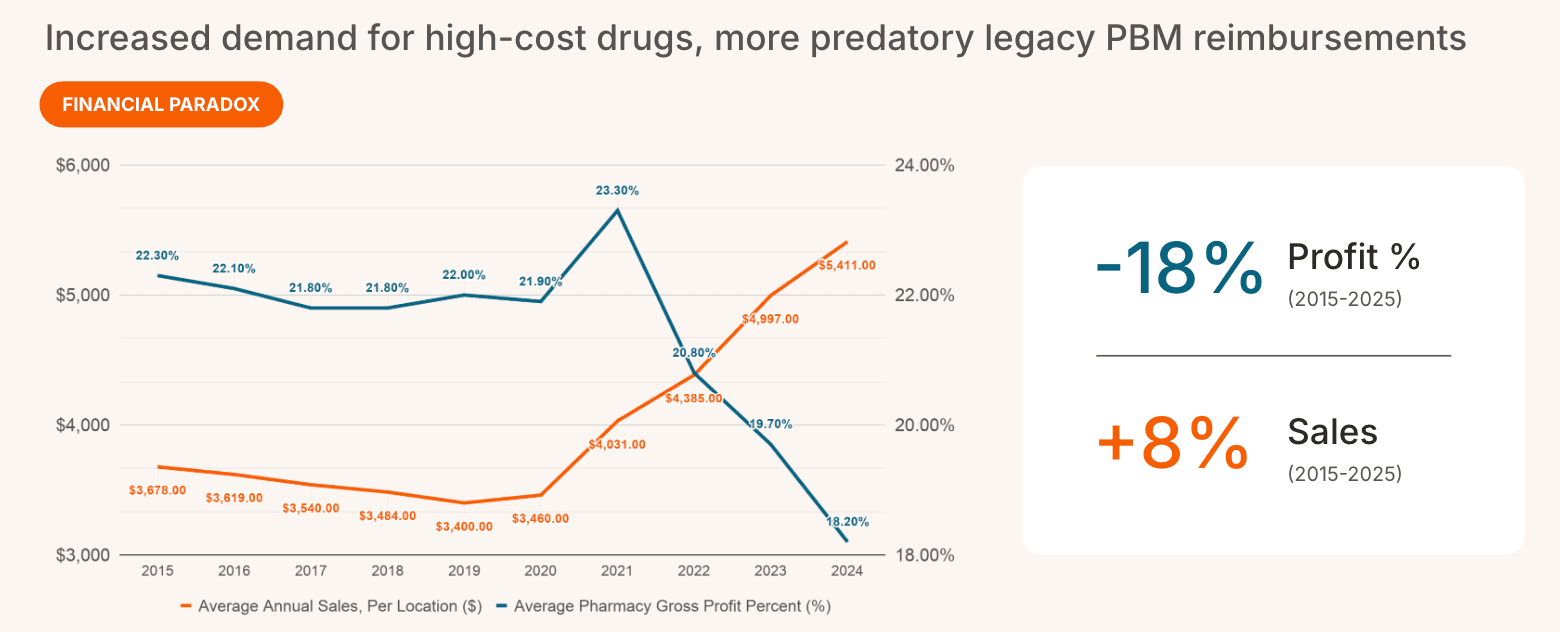
The National Community Pharmacists Association’s (NCPA) 2025 Digest reported data across the last 10 years, showing an interesting paradox of sales versus profit. Independent pharmacy locations saw an 8% increase in sales over the last decade, but profits have plummeted by 18%.
Interestingly, while macro market data reflects thinning profit margins despite rising top-line sales volume, local stores are forced to absorb rapid industry shifts on an entirely unequal playing field.
Why? Dr. Benjamin Jolley credits predatory reimbursement rates from legacy PBMs, “CVS reimbursed a CVS pharmacy $8,000 for Cinacalcet on the same day that they reimbursed an independent pharmacy $50. That is a mind-boggling amount of just taking, because [legacy PBMs] are in the position where [they] can.”
Legacy PBM Games: Unequal Reimbursement Rates
This theory is supported by two separate independent audits of legacy benefit manager practices. The State of Tennessee's audit of Caremark (CVS) exposed staggering, same-day reimbursement disparities for identical products. As Dr. Jolley mentioned, this report found CVS paid its own corporate pharmacy line $8,000 for Cinacalcet, while reimbursing an independent competitor just $50. On Tadalafil, a pulmonary hypertension drug, CVS reimbursed affiliated pharmacies up to 100x more than independent competitors.
The 2024 FTC Interim Report on PBM Markups also showcased how vertically integrated entities exert substantial influence to favor their own fulfillment lines. PBMs which own, or are affiliated with, subsidiary pharmacies showed preferential reimbursement rates thousands of percent higher than competitor pharmacies.
Findings from the 2024 FTC Interim Report on PBM Markups
Medication | Indication | PBM Markup % |
Adcirca (Tadalafil) | Pulmonary Hypertension | 7,736% |
Tecfidera (Dimethyl Fumarate) | Multiple Sclerosis | 2,121% |
Gleevec (Imatinib) | Oncology | 5,232% |
As the volume of high-list-price drugs prescribed, like GLP-1s, continues to soar, independents lose out on fair reimbursement, and are forced to close their doors, leaving communities with critical gaps in access.
The Value of Independent Pharmacies: Clinical, Community Anchors
When viewed from a ‘savings-only’ lens, employers may miss the true clinical value that independent pharmacies offer their members. National drugstore chains have increasingly cut labor budgets, leaving skeleton crews to manage an ever-growing prescription volume per location. (Across fewer locations as well, with CVS and Walgreens closing thousands of locations in recent years).
To handle the strain, major retailers have implemented automated systems that route to bots rather than connecting to a live human, and in most cases a real pharmacist or technician will never answer the phone.
In contrast, independent pharmacies operate with human-to-human accountability. Given pharmacists are highly accessible healthcare professionals (with patients interacting with them 12x more frequently than primary care physicians), local pharmacists are uniquely positioned to recognize concerning health trends and help manage chronic conditions.
Real Interventions, Real Savings
Dr. Jolley knows firsthand the importance of independent pharmacists on the health of their patients. They’re members of their communities, as demonstrated by two of Dr. Jolley’s personal anecdotes:
Clinically-Appropriate, Lower-Cost Overhauls: Dr. Jolley reviewed the therapy profile of a patient with diabetes who had been visiting a charitable clinic. The clinic had prescribed older, lower-cost medications that have harmful side effects with long-term use. Recognizing that the patient actually had an excellent commercial health plan, he cross-referenced her formulary, contacted her doctor who switched her to modern, cardioprotective and stroke-protective therapeutics at an equal or lower out-of-pocket cost.
Leveraging OTC Solutions for Improved Outcomes: While consulting a mother picking up insulin for her son with Type 1 diabetes, Dr. Jolley reviewed her personal history with Type 2 diabetes. He educated her on the benefits of continuous glucose monitoring (CGM) even in early-stage disease management. She purchased an over-the-counter monitor, an intervention proven to drop a patient's A1C by 0.5% to 0.7%, a shift that helps prevent blindness, strokes, and kidney failure.
The True Cost of Pharmacy Deserts
When an independent pharmacy is driven out of business by low PBM reimbursements, there are often few options to fill that gap, especially in rural areas where big box pharmacies are few and far between (50% of pharmacies in non-metropolitan areas are independents). A study published in the Journal of the American Medical Association (JAMA) highlighted that the closure of a local pharmacy correlates to an immediate drop in medication adherence, a sharp spike in emergency room visits, and an increase in patient mortality rates.
For a self-funded employer plan, losing a local pharmacy can mean a member’s highly predictable, low-cost pharmacy line item, such as a blood pressure medication, turns into a costly medical claim, like an ER visit.
"Metformin and almost all of the anti-hypertensive agents I can think of are less than 10 cents a pill, but the cost of someone not controlling their high blood pressure can result in… extremely high-cost procedures."
Dr. Benjamin Jolley, Independent Pharmacy Owner and Advocate
The Path Forward for Plan Sustainability & Independent Practice
True sustainability requires a PBM model that decouples itself from vertical monopolies, realigns economic incentives, and empowers local clinical networks, such as independent pharmacies, to practice efficiently.
As for SmithRx’s part in bolstering the independent pharmacy ecosystem, over 50% of SmithRx’s contracts operate on a cost-plus model, ensuring pharmacies are reimbursed fairly based on the true acquisition cost of the drug plus a clear, predefined dispensing fee.
Additionally, SmithRx is one thing, and one thing only: a pharmacy benefit manager. This means we have no incentive to steer patients towards particular drugs or particular pharmacies, or obscure the real costs billed from pharmacies to plans. In the end, with a modern PBM like SmithRx, employers see the actual cost of the medication without hidden corporate markups or arbitrary spread pricing.
In action, this takes the form of tools like SmithRx’s Find My Meds, which empowers members to see real costs at all of their local pharmacies, including independents, to make informed decisions on where they give their business.
Actionable Steps for Plan Sustainability
For self-funded employers and benefits brokers, protecting your plan and workforce requires action items:
Audit Your PBM Structure: Ensure your pharmacy benefits manager does not have a financial incentive to steer your employees away from trusted community anchors toward automated corporate chains.
Demand Radical Transparency: Transition to modern, flexible PBM models that leverage cost-plus contracting and 100% rebate pass-through to ensure your premium dollars pay for actual care, not corporate vertical margins.
Choose Partners That Empower Independents: Select a PBM with helpful plan member tools, like SmithRx’s Find My Meds, to empower members to cross-reference prices, support local independent pharmacies, and access the vital human touch that keeps your workforce healthy.
Want to dive deeper into pharmacy policy and transparent benefits? Watch the complete Full Disclosure episode or connect with the team on LinkedIn or check out our full library of educational resources and legislative deep dives.
SmithRx
SmithRx is the #1 Modern PBM, relentlessly focused on eliminating the conflicts and complexity of legacy pharmacy benefits. Built on radical transparency and fiduciary alignment, we empower employers to take control of their pharmacy spend and experience with our 100% pass-through model.