
Modern PBM

Alan Pannier
Key Takeaways
A pass-through contract from a PBM that also runs spread pricing for other clients can cost more than it appears.
Annual average rate guarantees can let a PBM pay pharmacies more on pass-through claims than spread claims.
Employers should verify rebate terms, claim-level data, and audit rights before trusting a pass-through label.
Originally Published November 16, 2023 | Updated November 16, 2026
Many employers choose, what they believe, is a pass-through contract with their pharmacy benefit manager (PBM) to see exactly what the plan pays for each prescription. When the same PBM also runs spread pricing for other clients, that contract can cost more than it appears.
Annual average pricing guarantees with pharmacies give the PBM room to pay higher rates on pass-through claims, bill those rates to the plan, and widen the margin it keeps on spread clients. The protection lies in contract terms an employer can verify and in a PBM that applies one pricing approach to every client.
Big PBMs Offer Clients "Pass-Through" Pricing Deals
Big PBMs like OptumRx, Caremark, Prime, and Express Scripts have heard the market demand for more transparent pricing and clearer contracts, and they have responded by offering a “pass-through” option for some of their clients. Under a pass-through arrangement, the plan pays the same amount the PBM reimburses the pharmacy, and the PBM earns its revenue through disclosed fees.
For employers that have pushed for visibility into drug spend, the offer looks like progress. The contract label, however, does not show how the PBM pays pharmacies across its full book of business.
How Average Pricing Guarantees Shift Costs to Pass-Through Clients
Years ago I worked for a PBM that offered both traditional pricing and pass-through pricing to our clients. The goal of offering both was to get an equal number of clients under both models.
Internally, we called the reason "MAC list arbitrage," a reference to the maximum allowable cost (MAC) lists PBMs use to set reimbursement for generic drugs.
PBMs have contracts with pharmacies that require them to pay a certain amount for certain categories of drugs on average throughout a given year. The on-average part is critical because it means that PBMs can vary the price that they pay the pharmacy depending on which of their clients is buying the drug.
This creates strange situations where the same drug, from the same PBM, at the same pharmacy can have significantly different costs. The chart below from 3 Axis Advisors illustrates this in practice:
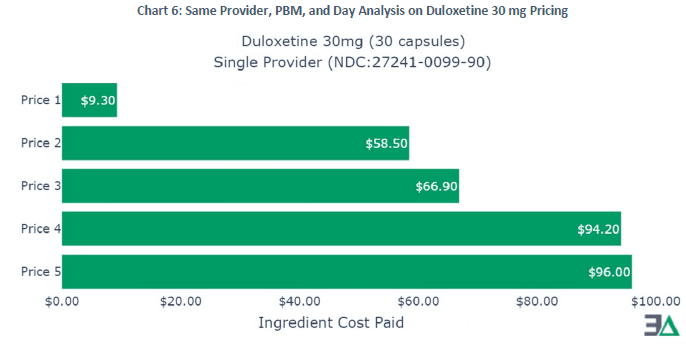
If you accept a pass-through deal from a Big PBM, the PBM can pay the pharmacy a higher price for your members' claims than the average it needs to hit over the year, then pass that higher price on to you.
For their spread clients (spread means that the PBM adds an additional margin to the cost of the drug between the pharmacy and the client), Big PBMs do the opposite. They pay the pharmacy an amount that’s lower than the average price that they need to pay the pharmacy over the course of the year. This gives the PBM plenty of room to add more margin on top of that lower price, which it then keeps for its own profit.
Because of this game, being on a pass-through contract with a PBM that also sells spread pricing puts the plan in a weak position. The plan can pay more for its prescriptions, and those higher pharmacy payments give the PBM room to take larger margins from its spread clients, a form of client cross-subsidization.
How to Verify a Pass-Through Contract
A pass-through label describes one contract feature. It does not show whether the PBM's incentives align with the plan, so employers need terms they can test against their own claims data. These questions can anchor an RFP or a renewal review:
Does the PBM apply the same pharmacy pricing approach to every client, or does it also sell spread pricing on other contracts?
How does the contract define rebates, and which manufacturer payments fall outside that definition?
Will the plan receive claim-level data showing what the PBM paid the pharmacy for each prescription?
What audit rights does the plan have?
For a fuller set of terms to test, see our PBM contract audit checklist.
Federal oversight is moving in the same direction. Under the Department of Labor's 2026 final PBM fee disclosure rule, PBMs serving self-insured plans of employers with 100 or more employees, or plans with 100 or more participants, will have to disclose their direct and indirect compensation, including spread compensation, before contracting and every six months after. Those plans will also be able to audit the PBM at least once a year. The rule takes effect January 4, 2027, and applies to plan years beginning on or after July 1, 2027. As the rule's Federal Register text notes, it does not prohibit spread pricing, so for now the contract itself remains the employer's main protection.
How SmithRx Approaches Pass-Through Pricing
Employers leaving a legacy PBM often want proof that pass-through pricing covers the PBM's entire book of business. At SmithRx, we never take spread for any of our clients. We combine transparent economics with a fixed per-member, per-month (PMPM) administrative fee and 100% pass-through of manufacturer rebates, so our compensation does not increase if medication costs rise.
Our client agreements commit to no forked pricing or client cross-subsidization, which our platform-based pricing model is built to support. That structure keeps our incentive tied to lowering net drug costs for every client. Plans comparing PBMs can use our PBM Evaluation Guide to test these terms.
A pass-through contract delivers its full value when the PBM behind it has no spread business to subsidize. Employers that test pricing, rebate, data, and audit terms before renewal will know which kind of pass-through they are buying.
Frequently Asked Questions
Who are the three largest PBMs?
The three largest PBMs are CVS Caremark, Express Scripts (owned by Cigna), and Optum Rx (owned by UnitedHealth). Their scale and vertical integration give them broad influence over formularies and pharmacy reimbursement, so employers should review their contract terms closely.
Does pass-through pricing guarantee lower drug costs?
Not on its own, because pass-through describes how pharmacy costs are billed to the plan. Total plan cost also depends on rebate terms, formulary decisions, clinical programs, and how the PBM is compensated.
Does the Department of Labor PBM fee disclosure rule apply to fully insured plans?
The rule's detailed disclosure and audit requirements apply to self-insured plans of employers with 100 or more employees, or plans with 100 or more participants. Fully insured plans and smaller self-insured plans receive only the general compensation disclosures required by statute, which makes their contract terms especially important.
Alan Pannier
Chief Strategy Officer, SmithRx
Alan oversees the company's pharmacy initiatives, including manufacturer relations, network management, and clinical solutions. His background includes clinical leadership roles at Magellan Health and Veridicus Health, as well as hands-on experience as a practicing pharmacist. Alan's academic credentials include an MBA and PharmD from Idaho State University, a Bachelor's in Chemistry and Business from Westminster College, and specialized training in managed care pharmacy. His comprehensive understanding of the industry drives SmithRx's innovative approach to pharmacy benefits management.


