Employer Strategies

SmithRx
Key Takeaways
Aggregate discount and rebate guarantees can incentivize a PBM to shift members toward expensive, high-rebate drugs.
A high-rebate brand drug can improve a PBM's guarantee results while raising total plan cost.
Plan cost over time, PMPM cost, and per-claim cost show whether a PBM's guarantees lowered plan spend.
Original Publish Date: November 16, 2023 | Updated: November 6, 2026
When a pharmacy benefit manager (PBM) reports that it met its contract guarantees, the natural conclusion is that the plan saved money. That conclusion can be wrong, because guarantee performance and plan cost can move in opposite directions.
We have previously discussed the standard methods used to evaluate PBMs and how contract definitions affect PBM transparency and accountability. Drug utilization mix matters just as much. When a plan evaluates PBM performance using aggregate pharmacy network discounts and rebate payments, the PBM can have an incentive to focus less on controlling cost and more on increasing utilization of guarantee-rich products, so its discount and rebate performance can improve while plan costs increase. Measuring plan cost directly is how employers tell the difference in real outcomes.
What Are PBM Performance Guarantees?
Performance guarantees are contract commitments in which a PBM promises to reach specific pricing targets, most often aggregate pharmacy network discounts and manufacturer rebate payments, and to reconcile with the plan sponsor when it falls short. A guarantee-rich product is any medication with a greater-than-average pharmacy network discount or rebate payment.
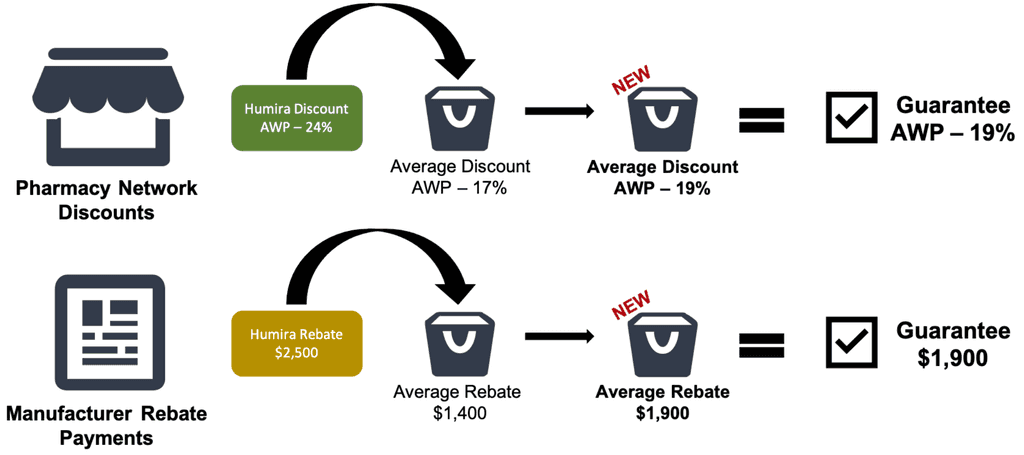
When a PBM increases utilization of these products, its position on guarantees can improve even as plan costs rise, given that those products are high-cost drugs. The Department of Labor (DOL) described the same concern in its October 2026 final rule: because rebate guarantees are typically presented in aggregate regardless of which drugs are dispensed, they can incentivize PBMs to prioritize higher-rebate drugs.
The schematic below (originally published in 2023) illustrates how adding a high-cost, guarantee-rich drug like Humira can improve discount and rebate performance even as plan cost increases. The same arithmetic can apply to other high-list-price, high-rebate brand drugs.
Humira has faced biosimilar competition since January 2023, and PBM coverage has since changed, according to a 2025 commentary in the Journal of Managed Care & Specialty Pharmacy.
How to Tell Whether Your PBM Saved You Money
A guarantee report answers a narrow question: Did the PBM hit the discount and rebate targets written into the contract? Plan sponsors need the answer to a broader one: did the plan pay more relative to utilization trends? It's crucial to measure:
Plan cost over time, which shows whether total pharmacy spend is rising, flat, or falling across contract years.
Per member per month (PMPM) cost, which adjusts spend for membership changes so the plan can compare periods and benchmarks.
Per-claim cost, which shows what the plan paid for individual drugs and reveals shifts in drug mix that aggregate rates conceal.
Request claim-level reporting so your team or consultant can compare the guarantee reconciliation with actual net plan cost. Compensation structure matters as well, because a 100% pass-through arrangement returns all manufacturer rebates to the plan, which removes the rebate margin a PBM could otherwise retain on higher-rebate drugs.
A PBM that reports strong guarantee results while PMPM costs climb should be able to explain the gap drug by drug at renewal.
What the DOL's PBM Fee Disclosure Rule Changes for Employers
In October 2026, the Department of Labor's PBM fee disclosure final rule set out what PBMs and their affiliated brokers and consultants must disclose to fiduciaries of large self-insured group health plans, generally those with 100 or more participants. Initial disclosures must cover manufacturer payments, including what passes to the plan and what the PBM retains, spread compensation by drug and pharmacy channel, and the net price the plan will pay after rebates and fees. Semiannual disclosures then let plans compare actual compensation with the amounts first disclosed, and plans may audit those disclosures annually using an auditor they choose.
The requirements apply to plan years beginning on or after July 1, 2027, and build on ERISA disclosure amendments that were part of the federal PBM reform enacted in February 2026. The rule does not remove the incentive on its own, because the DOL states that it does not prohibit spread pricing or require PBMs to pass through all rebates. A separate provision of the Consolidated Appropriations Act, 2026 requires PBMs to pass through rebates, fees, and alternative discounts to group health plans for plan years beginning on or after August 3, 2028, so until then, contract structure and cost-based measurement remain on the plan sponsor's evaluation list.
How SmithRx Lowers Total Plan Cost
We hold ourselves to the same measures we recommend for evaluating any PBM: plan cost over time, PMPM cost, and per-claim cost. SmithRx combines transparent economics with a fixed PMPM administrative fee and 100% pass-through of manufacturer rebates, so the plan pays exactly what the pharmacy is paid and our compensation does not rise when drug costs do.
Through the SmithRx Partner Portal, we provide the data and analytics to help you understand what’s really going on with your pharmacy spend and actively help you reduce it. Get in touch with a SmithRx team member to learn more about how we help plans save 20%+ on average.
Frequently Asked Questions
What is a PBM rebate guarantee?
A PBM rebate guarantee is a contract commitment to deliver a minimum level of manufacturer rebates, with any shortfall reconciled to the plan. Because rebates vary by drug and contract definitions control which claims count, a plan can receive its guaranteed rebates while its net drug cost rises.
Is a pass-through PBM the same as a transparent PBM?
Pass-through describes a contract feature in which the PBM passes pharmacy pricing and manufacturer rebates to the plan without markup, while transparency describes how fully the PBM discloses its pricing, fees, rebate terms, and claims data. Employers should evaluate each separately, along with how the PBM is compensated and what data the plan can access.
Does the 2026 DOL PBM disclosure rule apply to smaller or fully insured employer plans?
The rule's detailed disclosure requirements apply to service providers of large self-insured group health plans, generally those with 100 or more participants or offered by employers with 100 or more employees.
SmithRx
SmithRx is the #1 Modern PBM, relentlessly focused on eliminating the conflicts and complexity of legacy pharmacy benefits. Built on radical transparency and fiduciary alignment, we empower employers to take control of their pharmacy spend and experience with our 100% pass-through model.


